Underwriting
  • Research and White Papers
  • June 2026

Resting Heart Rate: The heart of underwriting decisions

By
  • Kishan Bakrania
  • John Cardus
  • Guizhou Hu
  • Dr. John J. Lefebre
  • Richard Russell
  • Dr. Nico van Zyl
Skip to Authors and Experts
Woman with a heart rate monitor on her finger
In Brief

RGA analyses and external research studies consistently demonstrate that RHR is a powerful, independent predictor of all-cause mortality across different populations – offering predictive value that matches or exceeds conventional underwriting factors. RGA is now translating research into practice through strategic and ongoing integration of RHR into our underwriting philosophy.

Key takeaways

  • Resting heart rate (RHR) is a powerful, independent predictor of mortality, with evidence showing it can match or exceed traditional underwriting factors such as blood pressure, cholesterol, and BMI.
  • RHR adds meaningful incremental insight to underwriting decisions, capturing underlying health risks that are not fully reflected in conventional metrics.
  • RHR is practical, accessible, and increasingly actionable, with widespread availability through EHRs, medical exams, and wearable devices, and active integration into tools such as RGA’s ASAP Infinity to support real-world underwriting decisions.

Introduction

Resting heart rate (RHR) is one of the simplest health metrics to measure, yet it has been significantly underused in life insurance underwriting.1 According to Harvard Medical School, “One of the easiest, and maybe most effective, ways to gauge your health can be done in 30 seconds with two fingers. Measuring your resting heart rate (RHR) – the number of heart beats per minute while you’re at rest – is a real-time snapshot of how your heart muscle is functioning.”2

Click graphic to enlarge
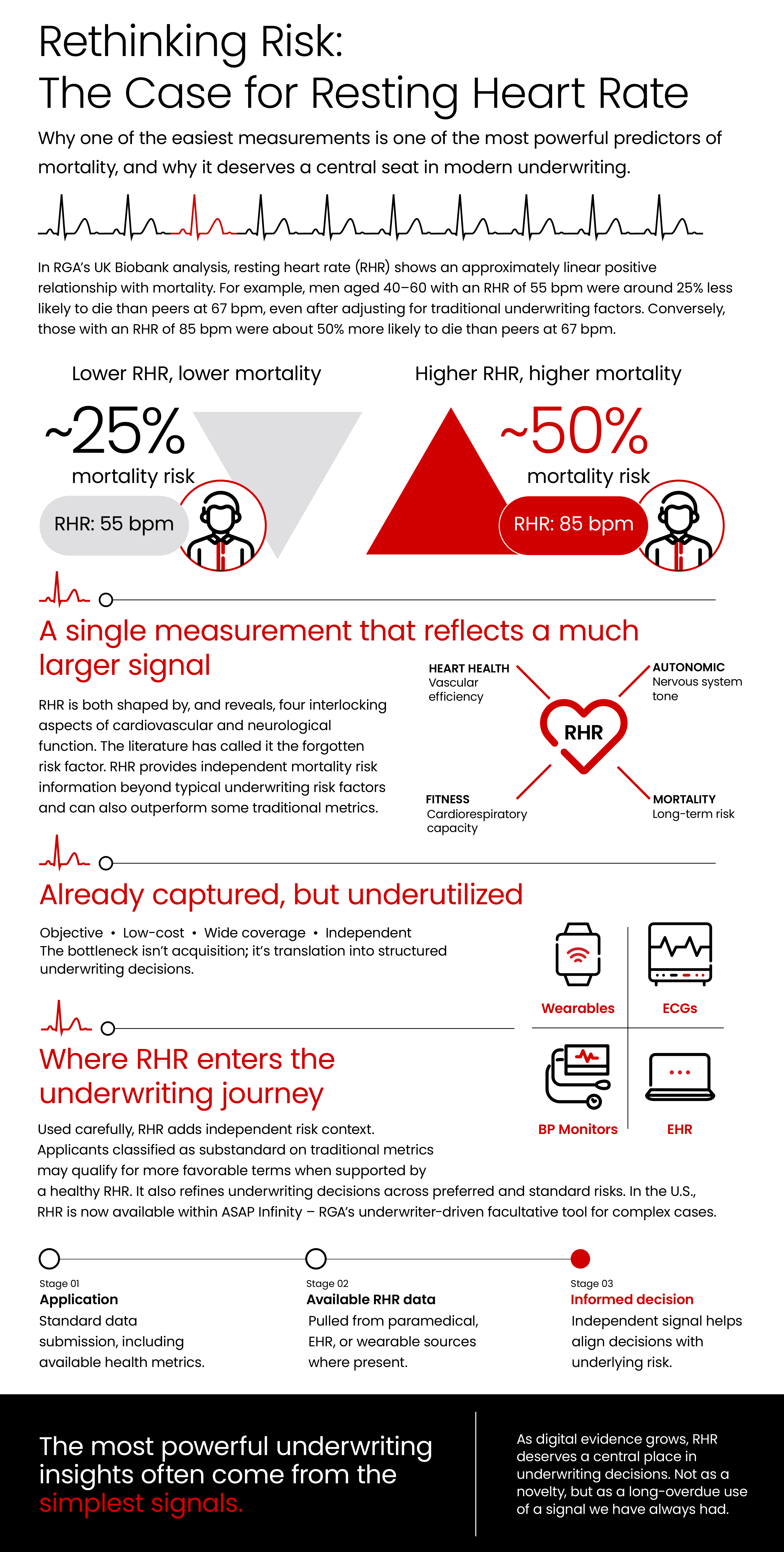
Infographic summarizing the benefit of resting heart rate to risk analysis

A research paper published in 2025 describes RHR as the “forgotten risk factor” and concludes that “RHR should be regarded as a vital clinical sign measured and evaluated at all clinical visits.”3 The study demonstrated that elevated RHR in young adulthood to middle age served as a better predictor of all-cause mortality than hypertension.

What makes RHR particularly compelling for insurers is that it serves as a strong, independent predictor of mortality risk that adds value above and beyond traditional underwriting factors like blood pressure, cholesterol, and BMI.

From an underwriting perspective, RHR acts as a proxy for cardiorespiratory fitness, autonomic function, and underlying health issues – capturing risk not fully reflected in traditional metrics.4,5,6 Importantly, RHR also offers practical advantages for underwriting: It is non-invasive, aligns well with current practices, is relevant across life and health products, and can be integrated into existing systems.

RHR data is now widely available through multiple sources: electronic health records (EHRs), medical exams, electrocardiograms (ECGs), and wearable devices. Notably, photoplethysmography (PPG) technology – embedded in smartphones and smartwatches – has demonstrated excellent agreement with the gold-standard ECG in multiple validation studies, making RHR measurement practical and accessible at scale.7,8,9

Family with father giving son a ride on his back
Turn biometric insights into business results through a partnership with RGA.

RGA’s extensive research

RGA’s broad research across multiple databases demonstrates that RHR is a robust predictor of all-cause mortality. For example, in RGA’s UK Biobank study, male individuals aged 40 to 60 years with an RHR of 85 bpm were roughly 50% more likely to die than peers with an RHR of 67 bpm, even after adjusting for traditional underwriting factors (Figure 1). While RHR measurements should be interpreted in context (e.g., medication use), RGA’s research shows that the relationship between RHR and all-cause mortality is remarkably consistent in different subpopulations. This predictive relationship holds across different age groups, both sexes, standard and substandard lives, and those with chronic diseases. Such consistency, across different populations, confirms RHR as an independent risk factor that adds incremental value to traditional underwriting metrics.

One of the most remarkable findings from RGA’s UK Biobank research is that RHR significantly outperforms total cholesterol as a mortality predictor. Similarly, RHR can replace BMI without meaningful loss of predictive accuracy. Some of RGA’s findings relating to RHR were published in a peer reviewed academic article with the University of Leicester in March 2026 in Mayo Clinic Proceedings: Innovations, Quality & Outcomes.10

Translating research into underwriting practice

As digital data sources become a routine part of underwriting, focus has increased on both identifying new metrics and making better use of the breadth of risk information already available to inform underwriting decisions. Within this context, RHR provides incremental risk information for underwriters. RGA is actively translating RHR research into underwriting practice. In the U.S., RHR is now available within ASAP Infinity – RGA’s underwriter driven facultative tool for complex cases.11,12 This helps bring evidence‑based insights into everyday underwriting judgments.

Figure 2 shows how RHR can be used as part of the underwriting process. For example, an applicant who might be classified as substandard based on traditional metrics may qualify for more favorable terms when supported by a healthy RHR. Similarly, RHR can be used to refine underwriting decisions across preferred and standard risks.

RGA is focusing implementation on facultative and preferred underwriting outside the U.S., while exploring other potential use cases. In this context, RHR offers a practical way to differentiate underwriting decisions, using meaningful evidence rather than unnecessary complexity.

Conclusion: Keeping fingers on the pulse 

Underwriters should recognize the value of heartbeat metrics, particularly RHR. The growth of digital underwriting evidence, alongside advances in biosensors and wearable technology, means this information is increasingly available at the point of underwriting. As a result, guidelines must evolve to reflect the full breadth of relevant risk data now routinely available to underwriters.

The opportunity to improve underwriting accuracy using heart rate information is no longer theoretical. Making better use of this data can deepen understanding of individual risk, support more proportionate evidence requirements, and help ensure premiums remain aligned with underlying risk – creating benefits for both insurers and clients.


More Like This...

Meet the Authors & Experts

Kishan Bakrania
Author
Kishan Bakrania
Lead Biometric Data Scientist, Global Research & Developmental Science
John Cardus
Author
John Cardus
Vice President, Head of Global Underwriting Philosophy & Education
Guizhou Hu
Author
Guizhou Hu
Vice President, Head of Risk Analytics, Global Underwriting, Claims, and Medical 
John-Lefebre-Professional-Headshot
Author
Dr. John J. Lefebre
Vice President and Senior Technical Global Medical Director, Global Medical 
Richard Russell
Author
Richard Russell
Vice President, Biometric Research, Global Research and Development
Nico Van Zyl Professional Headshot
Author
Dr. Nico van Zyl
Senior Vice President, Chief Medical Director

References

  1. https://www.rgare.com/knowledge-center/article/better-underwriting-decisions-are-just-a-heartbeat-away
  2. https://www.health.harvard.edu/heart-health/want-to-check-your-heart-rate-heres-how
  3. https://pubmed.ncbi.nlm.nih.gov/39894380/
  4. https://pubmed.ncbi.nlm.nih.gov/37167327/
  5. https://pubmed.ncbi.nlm.nih.gov/19376976/
  6. https://pubmed.ncbi.nlm.nih.gov/28552551/
  7. https://pubmed.ncbi.nlm.nih.gov/28288955/
  8. https://pubmed.ncbi.nlm.nih.gov/36016077/
  9. https://pubmed.ncbi.nlm.nih.gov/36104356/
  10. https://pubmed.ncbi.nlm.nih.gov/41883351/
  11. https://www.rgare.com/knowledge-center/article/spectrum-shift-a-call-for-a-hybrid-approach-to-the-complex-and-accelerating-facultative-market
  12. https://www.youtube.com/watch?v=wcfRpsIQHSw&list=PLsq7R72-vV5Epqd6zKDf8rSCiG60I_2e4&index=8