Behavioral Science
  • Research and White Papers
  • June 2026

From Complexity to Confidence: Applying behavioral science to annuity decisions

By
  • Shilei Chen
  • Lizzy Lubczanski
  • Rosmery Cruz
  • Peter Hovard
Skip to Authors and Experts
Older gentleman flying a kite with his wife.
In Brief

Retirees face complex decumulation decisions but have limited understanding of lifetime annuities. RGA research shows behavioral biases and low comprehension suppress uptake. Simplified, better-framed communications can improve understanding and increase willingness to annuitize – but product and system design must also evolve.

Key takeaways

  • New RGA research reveals that many retirees do not understand lifetime annuities well, with participants answering only about half of basic product questions correctly and often misinterpreting key features.
  • Behavioral biases – including loss aversion, preference for flexibility, and inertia – reduce willingness to annuitize, even when annuities provide guaranteed lifetime income.
  • Simplified, better-framed communications improve comprehension, attitudes, and allocation to annuities, but communication alone does not fully overcome structural and behavioral barriers.


Executive summary

Decumulating savings presents a significant challenge for a growing proportion of retirees with defined contribution savings plans, requiring an understanding of longevity, market, and behavioral risks. In fact, decumulation has been dubbed the “nastiest, hardest problem in finance” by Nobel Laureate economist William F. Sharpe.1 Lifetime annuities are a useful solution to this problem, but uptake remains low in many of the biggest retirement markets.

RGA’s behavioral science team conducted a two-part study of 1,200 UK-based retirees and near retirees (aged 50+) to understand perceived benefits and barriers of annuities (part one), as well as to test behavioral solutions to improve understanding and consideration of annuities (part two).  

Key findings

Part one:

First, we explored key perceived benefits and barriers to annuitization, finding:

  1. Annuities are complex, engagement is low, and comprehension of their technicalities and value proposition is poor. In our study, only half of the questions on a comprehension test were answered correctly.
  2. Most people incorrectly believe that appearing healthy when purchasing underwritten lifetime annuities leads to higher payouts.
  3. Desires for decumulation solutions are contradictory. People value security, certainty, and guarantees but simultaneously desire flexibility in annuity products.
  4. Cognitive biases make annuities unattractive, even when they could be beneficial. Lack of flexibility is a key barrier to annuitization, which reflects humans’ tendency to want control and choice, even when it comes at a cost. Similarly, people fear passing away early and losing money and dislike the irreversibility of choosing a lifetime annuity, reflecting the human tendency to disproportionately fear loss.
Part two:

Next, we tested whether behavioral techniques could mitigate these barriers using a randomized control trial in which participants saw different behaviorally enhanced versions of the same product information describing a fictional but realistic annuity. The study found that simplifying product information using specific behavioral techniques and framing it as a protection strategy led to significant improvements:

  1. Higher comprehension test scores
  2. More favorable attitudes toward annuities, measured using an implicit reaction time test (a behavioral neuroscience technique that reveals the strength of attitudes)
  3. Greater willingness to annuitize savings, measured using an allocation task
  4. Greater willingness to select protection features such as guarantees and value protection

Adding reassurance with social proof (highlighting “normal behavior”) had additional benefits of further increasing comprehension and the proportion of savings people were willing to annuitize.

Birdseye view of man in red shirt working on a laptop
RGA’s behavioral science team provides business-altering insights across the insurance value chain.

A case for behavior-aware product design, distribution, and underwriting

The study results show that simplifying and reframing product positioning using behavioral techniques can be a cost-effective strategy for providers, trustees, sponsors, and others to meaningfully improve consumers’ understanding and reduce reluctance to annuitize.

These techniques aim to encourage informed understanding and engagement. To truly close the gap – acknowledging the impact of inertia and behavioral biases – behavior-aware approaches can be integrated within product design and alongside distribution. These should be combined with attempts to promote informed decisions and engagement. For example:

  • Create personalized default decumulation pathways as a fallback option for when retirees fail to actively choose. This could include annuitization for retirees who would benefit, while preserving choice to select alternatives. However, a range of behavioral implications must be taken into account when designing defaults.
  • Mitigate the sense of locking away capital with “flex then fix” solutions and phased annuitization.
  • De-silo accumulation and decumulation decisions to capitalize on limited moments of engagement.
  • Optimize underwriting forms to improve disclosure accuracy, thereby promoting wider access to enhanced rates for those entitled to them.

Applying behavioral approaches can improve understanding and access to annuities, helping consumers solve the challenge of retirement finance decumulation. 

The rise of defined contribution plans: Opportunities, challenges, and puzzles 

As life expectancy continues to rise globally and populations age, the growing risk of people outliving their savings is becoming a significant challenge for governments, insurers, and consumers.2 In retirement savings, defined contribution (DC) plans now dominate defined benefit (DB) plans in many markets. DC plans accounted for 59% of total assets in 2025 for the seven largest pension markets globally, known as the P7 – U.S., UK, Japan, Canada, Australia, Netherlands, and Switzerland – compared with just 40% in 2004.3 In the UK, the private sector has seen a steep decline in DB plans, falling from 3.5 million active members in 2006 to less than 0.9 million in 2022.4 Conversely, around 9.3 million people were enrolled in DC workplace pension plans in 2024.5 In the U.S., once-common DB plans in the private sector are now rare, replaced by DC plans such as the 401(k).6 More assets are currently held in DC plans in the U.S. than ever were held in DB plans.7 

Senior couple walking outside in fall

With DC plans dominating, consumers have more choice for managing their retirement finances than ever before. For example, as a result of the 2015 Pension Freedoms Act in the UK, retirees can decide to leave their funds invested and draw down flexibly as they see fit – or purchase lifetime annuities.8 Similar choices are available to U.S. retirees, who can leave the funds invested, transfer among accounts, withdraw a lump sum, or take an annuity.

However, giving consumers greater freedom has also shifted risk ownership and decision-making responsibility. Those with DC plans now personally bear the risks of their investments, inflation, outliving savings, and their own ability to manage their funds. Drawing down too much cash too quickly increases the risk of depleting savings early – 20% of UK retirees admitted being “retirement over-spenders” in a nationwide survey9 – and missing out on investment returns. In extreme cases, this can result in retirees running out of money. Meanwhile, withdrawing too conservatively – a challenge that has been realized in Australia’s superannuation fund system10 – can limit quality of life, allow inflation to erode value, and expose savings to market volatility.

These difficult choices can mean the difference between a comfortable retirement and financial hardship. Decumulation decisions are complex and unfamiliar to consumers and fertile ground for a range of cognitive biases that disrupt good decision-making.11  Resulting risks pose problems for both individuals and society – and a growing challenge for the retirement finance industry.

The lifetime annuity solution

Annuitization is a solution to the decumulation challenge. By converting DC plan savings into guaranteed income for life, annuities balance consumption through retirement, giving retirees financial security and predictability, shelter from volatile markets, and freedom from many difficult, ongoing financial decisions.

Despite annuities’ advantages, uptake is unexpectedly low – a problem referred to by economists as the “annuity puzzle.”12 That said, annuity sales have recently surged due to rising interest rates and continue to grow in several markets, including the UK13 and U.S.14,15 They are projected to grow significantly in markets with emerging middle classes, such as China, India, and Southeast Asia.16  But they remain a minority choice.

  • Only 9% of UK retirees purchased annuities when they first accessed their pensions. 
  • Just one in five American pre-retirees own an annuity. 
  • Just 5% of eligible Canadian retirees purchase an annuity.17 
  • Only 2% of Australian superannuation fund assets were annuitized as of June 2024.18 

Given the benefits of annuities for decumulation, the financial industry needs to understand the barriers preventing people from choosing them and develop solutions that inspire consumers to consider them.

A behavioral approach

Behavioral economics – the discipline that brings together psychology, economics, and related fields to understand human decision-making – is a useful tool for piecing together the annuity puzzle. In fact, behavioral science has played a pivotal role in increasing contributions during retirement savings accumulation. The most significant success has been creating schemes for automatic enrollment,19 which preserve individuals’ ability to opt out while ensuring participation in the event people fail to decide due to inertia. In the UK, auto-enrollment saw a tenfold increase in participation in workplace pensions as of 2019.20 Re-framing savings in terms of daily rather than monthly targets has also proved effective.21 Defaults such as auto-enrollment risk implicitly signaling a recommended contribution level rather than a minimum which in some cases may not be sufficient – leveraging an anchoring effect that encourages higher savings has been used to counter this.22,23  

However, much less attention has been paid to supporting effective decumulation. It is time to address this issue to ensure the industry can provide attractive and effective products that align with consumer attitudes and behaviors.

Woman sitting at a desk working on a laptop
Turn insights into action. The RGA behavioral science team can help your business across the insurance value chain.

Study one: Assessing benefits and behavioral barriers to annuitization

RGA’s behavioral science team recently conducted an extensive two-part study to understand perceived benefits and behavioral barriers to annuitization (part one) and test practical solutions to overcome these in product positioning (part two).

Testing perceived benefits and behavioral barriers to annuitization

Sample 

The study recruited 1,200 UK-based retirees and near-retirees (aged 50+) who were tentative or considerers of annuities but not current annuitants.

Testing comprehension

The hypothesis was that low comprehension of annuities is a barrier to uptake. To test this, the study asked participants a set of multiple-choice questions to determine their understanding of the purpose and technical features of annuities, including their understanding of the incentives to disclose health conditions and lifestyle factors during underwriting.

Ranking barriers and benefits

To explore how product features need to evolve to account for customer biases and attitudes, the study asked participants to rank aspects of annuities they find most appealing and most off-putting.


Annuity decisions are complex and understanding is low

People’s understanding of retirement finance is generally low. This is a consequence of the products’ inherent complexity, low levels of financial literacy,24 and little engagement with retirement savings while people are working – the “accumulation stage.”25 Considering and assessing the value of annuities requires people to mentally integrate their longevity risk, consumption continuity, and asset decumulation. These are abstract, unintuitive concepts shrouded in uncertainty and imperfect information.26 

Annuities can have many features, variations, riders, and pricing structures that make them hard to value.27 They are often described using opaque technical terminology, such as “deferred annuity,” “guaranteed income rider,” or “surrender charges.”

In our study, UK-based 50+-year-olds assigned to the control group with no behavioral enhancement correctly answered only half of the questions on a comprehension test of information about a fictional but realistic individual annuity product. Similarly, a 2024 U.S. study showed that only 9% of consumers felt very knowledgeable about annuities; for consumers who own an annuity, only 32% felt very knowledgeable.28 

Retirees may misunderstand the real risks they face and, hence, the value proposition of annuities. For example, individuals often underestimate the chance of living far beyond their expectations or finances29 and overestimate their ability to manage their money.30 In RGA’s study, participants ranked the benefits of annuities – “Expecting to live long enough that an annuity would be worthwhile” and “Protection against mismanaging one’s finances” – very low.

Low comprehension is a significant barrier to uptake.31 Although annuities are typically sold through independent financial advisers, very few people in the UK actively seek guidance – either from an adviser or from their employer.32 

Using professional advisers is more common among U.S. pre-retirees, with around 45% claiming to use them in a 2025 poll; wealthier Americans accounted for a large majority of this.33 

When understanding is low and complexity is high, people often find the easiest course of action is to avoid making a choice altogether, adhering to the default option, regardless of whether it is optimal. This phenomenon is known as “inertia bias.” Thus, retirees often leave pensions in drawdown status, where they feel more familiar, see the situation as less risky, and can take fewer actions.34 The industry and consumers would benefit from attempts to improve understanding, promote informed decisions about annuities as a decumulation solution, and create decision structures that acknowledge the influence of inertia.

Inertia bias – The tendency to stick with the status quo or avoid taking action even when it would be beneficial. 


Disclosure incentives are misunderstood for underwritten annuities

In some markets, such as the UK, consumers with reduced life expectancy can benefit from “enhanced” underwritten annuities that offer higher rates and, therefore, higher monthly payments. Despite the incentives to disclose accurately, consumers often fail to disclose medical conditions and lifestyle factors that could qualify them for enhanced rates. There are several possible reasons for this:

  1. Questions are unclear or difficult to answer accurately due to their design and wording.
  2. Questions are psychologically difficult to answer because they provoke shame, embarrassment, or guilt.
  3. Respondents misunderstand the incentives to disclose accurately, believing that appearing healthy would secure a better rate.

RGA’s latest research found the latter to be the case, while previous research has shown the first two points as important factors in inaccurate insurance disclosures.35 The latest study asked participants which of the following hypothetical applicants would receive the highest annuity payment:

  • One reporting excellent health
  • One reporting average health
  • One reporting poor health
  • One who avoided the health questions

Only 38% selected the correct answer (one reporting poor health), while 42% believed that excellent health would lead to the highest payout (Figure 1). Other UK studies have found that only 18% of consumers reportedly knew they could obtain a better annuity rate if they had a health condition.36 This highlights a misunderstanding of how lifetime annuity pricing works and could underpin non-disclosures and limit access to enhanced rates or features.


Contradictory desires for certainty and flexibility

When the study asked participants to rank the key benefits of annuities, the top responses were, on average, related to feelings of security provided by guarantees, protection from running out of money, and the certainty of knowing one’s monthly income (Figure 2). However, these benefits are at odds with how people view the drawbacks of annuities. Lack of flexibility, for example, was seen as a key drawback (Figure 3). Annuities require consumers to lock up otherwise-liquid capital in exchange for guaranteed income, which is seen as undesirable even if beneficial. Retirees desire both guarantees and flexibility, which is difficult to achieve.

The paradox of flexibility and choice

Cognitive biases – systematic deviations from economically rational decision-making that affect all humans – also stop retirees from considering annuities. RGA’s and other research  shows that people tend to prefer keeping their money accessible and flexible. People often overvalue flexibility,37,38 believing (often erroneously) that they will use options given to them in the future. This is known as “option value bias.”39 While desired, flexibility is not always beneficial. For example, a recent study from Sweden40 compared investors’ performance pre- and post-retirement. It found that people traded more frequently, held more individual stocks, and caused their portfolios to perform more poorly after retirement. More time to manage their money during retirement actually gave retirees more opportunity to mismanage it.


Behavioral science has argued that having too little choice can be damaging for people’s sense of autonomy and wellbeing; equally, having too much choice can lead to poor decisions – or failure to decide at all. This is known as the “paradox of choice.”41  Meanwhile, people value having control over their decisions even when relinquishing it could be beneficial – a bias known to behavioral scientists as “autonomy bias.” The RGA study found that preference for control over finances was ranked as the eighth-most-significant drawback (Figure 3).

Autonomy bias – A human tendency to value, trust, and prefer decisions we make for ourselves over those made for us by others. 


Given these biases, attractive decumulation solutions would preserve some sense of control and access to capital and provide security while avoiding overwhelming choices that could lead to poor decisions.

Loss aversion: Retirees fear regret, irreversibility, and poor value for money 

“Loss aversion” is a cognitive bias in which the expectation of the pain from losing something is felt more intensely than the pleasure of equivalent gains. People are cautious about giving up what they already have (known as the “endowment effect”)42 and fear potentially regretting loss-causing decisions.

Loss aversion and endowment effects – A cognitive bias where a situation is perceived as worse when framed as a loss than as a gain; therefore, people are more likely to retain an item they own than acquire the same item when they do not own it. 


In RGA’s research, consumers rated irreversibility and the fear of losing money due to early death as key drawbacks (Figure 3).


Academic studies show that individuals with higher levels of loss aversion are less likely to own annuities because they overestimate the possibility of dying early and “losing” their premium while undervaluing the upside of being protected if they live longer than expected.43 In practice, consumers think of annuities as risky gambles rather than insurance and are particularly sensitive to the possibility of “losing” their capital if they die early, even when the expected value of lifetime income is positive.44 

Man reading report on his computer
Dive deeper into the studies and research conducted by RGA’s behavioral science team.

Study two: Testing behavioral solutions

Simplicity as a solution

In order to help retirees make informed decisions about whether lifetime income is right for them, the biases need to be overcome and annuitization decisions need to be simplified. However, RGA’s research over several years shows that simplification of products, processes, and communication is often misunderstood.45 It is frequently equated with removing clutter, making journeys faster and communication shorter, or removing product features. While these all can be positive outcomes, often it is not possible or helpful to approach simplicity this way. Products such as annuities are inherently complex, and lengthy processes such as underwriting sometimes underpin access. Features and options produce choice for customers, and product information is often useful and necessary for customers, even if it appears lengthy.

In essence, some complexity is necessary for the products to function and is useful for customers. However, it needs to be positioned thoughtfully. To quote former Apple Chief Designer Jony Ive:

“True simplicity is derived from so much more than just the absence of clutter. It’s about bringing order to complexity.”

Simplification can also mean providing reassurance in the form of social proof; people often look to others’ behavior for guidance when making complex financial decisions.

Counterintuitively, simplification does not always mean reducing the amount of information. Sometimes it means adding thoughtfully presented information when it is useful for deciding or tactically introducing “positive friction” to a process to encourage consumers to engage and contemplate their decisions.

These techniques can be applied in communication, product design, and process to create customer journeys that enable better-informed decisions about annuitization.

Simplifying and reframing annuity product information

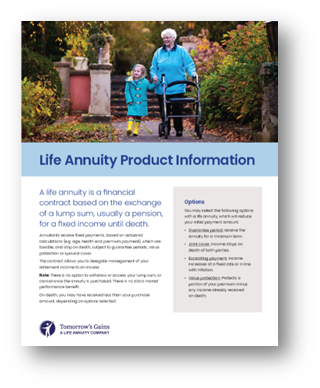
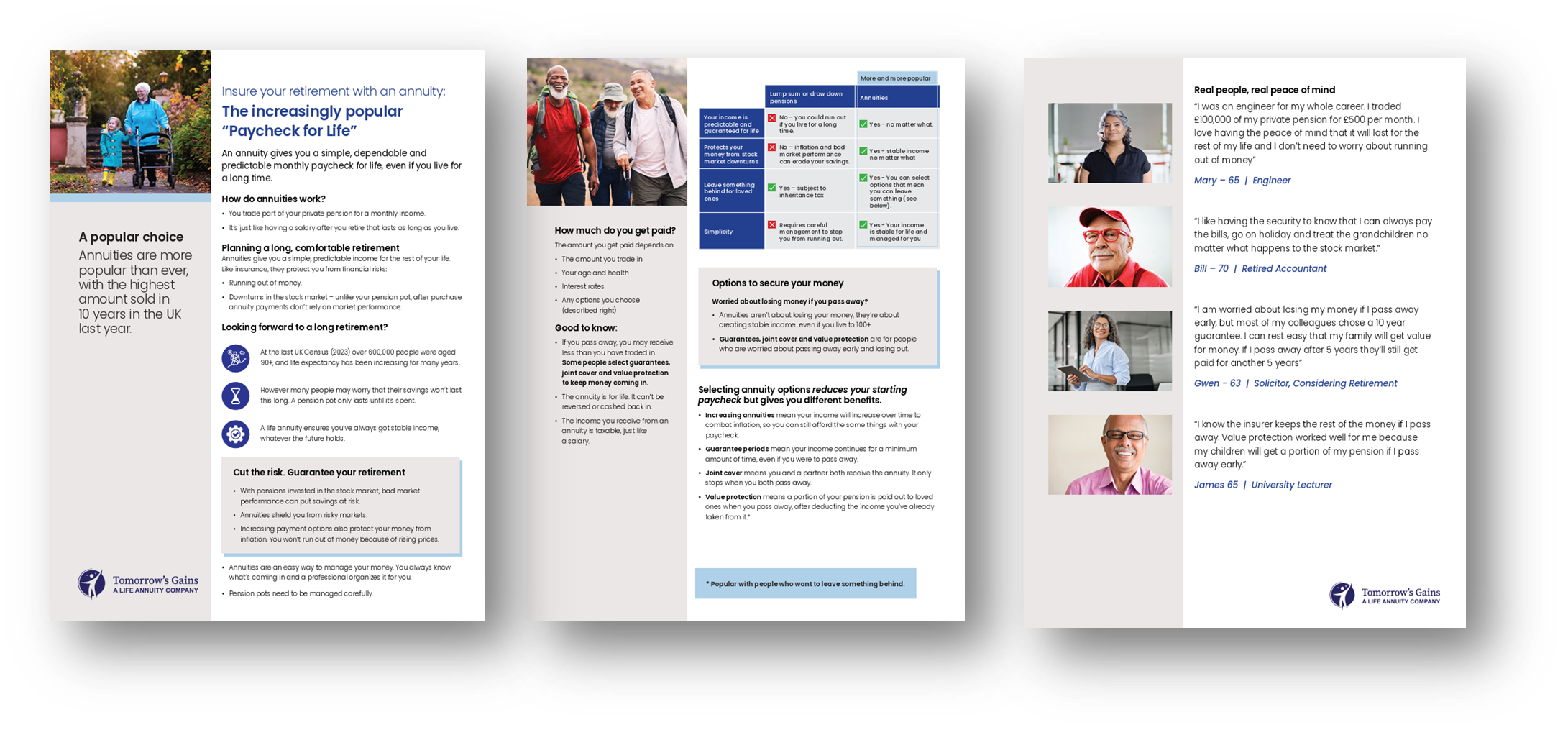
The RGA study tested whether applying behavioral science principles to simplify information about annuities, mitigate cognitive biases, and provide reassurance through social proof improves people’s comprehension, attitudes, and willingness to annuitize their DC savings.

Results

In these tests, the study found that deploying behavioral techniques to simplify, overcome biases, and provide reassurance produced strong outcomes. Simplifying the information and framing the annuity as protection appeared to be the key drivers. 

Attitudes

Attitudes toward annuities were more favorable when participants saw the enhanced information compared to the control information, driven by simplification and reframing. The study found that people felt more reassured, that they understood the product better, and that they had control over their finances.

Comprehension

Average scores on a multiple-choice comprehension test were 11% higher for those who saw the fully enhanced version, driven largely by simplification, which yielded 9% higher average scores alone.

Willingness to annuitize

Significantly more people were willing to annuitize any proportion of their savings when they saw the enhanced versions, driven by simplification and reframing. More people (150% more) also indicated they would annuitize all of their savings in this same comparison (Figure 6).


Participants willing to annuitize allocated 9% more on average when they saw the fully enhanced information compared to the control. The simplified version alone, and simplified + reframed versions, increased allocations by 7% compared to the control, but this difference was not statistically significant.

More people (39% more) selected five-year guarantees and value protection (26% more) when they saw the simplified and reframed information.

Implications for the retirement finance industry 

These insights have direct relevance to the retirement finance industry. Annuity providers, trustees, plans sponsors, administrators, and others with an interest in enabling retirees to make informed choices can apply the concepts of simplicity and reframing to their product literature as a quick and inexpensive way to increase consumer comprehension and overcome biases that reduce people’s willingness to annuitize.

Although this research was a simulation experiment, RGA’s previous work shows that applying similar techniques to optimize quote communication in live settings yields significant increases in conversion. The exact increase in sales is unpredictable. In one case, RGA improved comprehension and the proportion of people who accepted a quote by 48% by simplifying the information – despite increasing the length of the communication.46 This shows the link between comprehension and purchasing behavior likely by giving customers a more accurate, nuanced, and confident understanding of the products’ value proposition.

Deploying behavioral techniques can be a cost-effective strategy to improve understanding and mitigate cognitive biases that hinder informed annuitization behaviors. However, such strategies assume a level of engagement that is notoriously difficult to attain. To truly close the annuitization gap, solutions need to go further, applying behavioral techniques deep within product structure and distribution pathways.

A case for behavior-aware product design, distribution, and underwriting

Simplifying choices with default decumulation pathways

RGA research shows that applying behavioral techniques to product information can mitigate biases, improve understanding, and reduce reluctance to annuitize. However, more needs to be done to truly expand access. Behavior-aware innovation in product design and access is likely to move the dial further.

A senior couple relaxes on the couch, looking at a tablet

A central paradox for decumulation is that while the goal should be to promote engagement, understanding, and informed, rational choices, inertia is a key behavioral barrier to solve. Using default pathways to promote good outcomes if no decision is made is a powerful strategy to combat inertia. However, despite significant successes in encouraging retirement savings, there are currently a limited number of examples in which defaults are applied to DC decumulation. In the UK, the 2025 Pension Schemes Bill will require DC trustees to provide a default benefit solution for retirees from 2027, termed “Guided Retirement.”47 In the U.S., there is a precedent for in-plan annuities in which lifetime income can be positioned as a default allocation in 401(k) and similar plans. Studies show that the effect on annuity decisions is stronger when they are used further ahead of retirement rather than for near-future decisions, which has implications for selection of deferred annuities.

The power of default pathways prompts significant considerations. Compared to accumulation decisions, decumulation needs are significantly more heterogenous, and the decisions are irreversible, making it harder to ensure that a single default benefits most individuals. Personalized default pathways could be a solution but would introduce operational complexity and fiduciary risk and potentially challenge consumers’ trust.

Importantly, defaults are not behaviorally neutral: They inevitably act as implicit signals of correct or adequate financial choices, especially in cognitively demanding retirement contexts. While defaults are powerful tools for ensuring outcomes in the absence of active decision-making, techniques such as those described here should be used concurrently to promote understanding and mitigate biases where engagement can be achieved.

Deferring psychological pain: Flex then fix 

Deciding to annuitize savings is a major decision. It represents handing over a lifetime of savings and accepting the psychological burden of the risks and choices. Deferred annuities are a special case of this psychology. They are purchased now for payments that do not begin until a potentially distant future date, meaning forgoing immediate liquidity and spending power. This works against a powerful human tendency to prefer immediate rewards and avoid immediate pain over future rewards and pain, even when the future payoffs stand to be greater – known as present bias.

A model that has been termed “flex then fix”48 can counter this by enabling the participant to allocate some funds to a flexible pot and some to a deferred annuity. This commits people to securing future guaranteed income while mitigating the psychological pain of forgoing immediate capital by simultaneously retaining some liquidity and control.

Reducing psychological pain: Phased annuitization

Psychologically, enabling phased annuitization could represent a similar solution to flex then fix. Committing to buying regular smaller annuities over time with opt-out abilities could reduce regret aversion and push the pain of forgoing immediate liquidity to the future. The Save More Tomorrow program (U.S., 2004) achieved this in relation to savings accumulation. The program encourages employees to commit to future increases in savings rates timed around future pay raises and results in significant jumps in retirement savings.49 Similarly, a design where the commitment to annuitize escalating amounts is made early but without a significant present-day cost would help overcome the challenges of traditional deferred annuities that come at a cost to the individual long before feeling the benefit.

Deferring decisions: The engagement challenge

There are psychological challenges to deferring annuitization decisions with deferred annuities, flex then fix, and phased annuitization. Just as it reduces the emotional burden, deferring the annuitization decision could also reduce engagement. A major problem for retirement finance is humans’ poor ability to empathize with, and make decisions for, our future selves. In one famous study, researchers found that showing people artificially aged photos of themselves increased the amount they were willing to contribute to their retirement funds – the suggestion being that this increases empathy with the future self.50 Similarly, making a person’s future self feel more real or “salient” can encourage them to consider annuities.51  

Using behavioral techniques such as those described through this study will be essential for engaging customers on decisions around deferred annuities.

De-siloing accumulation and decumulation to capitalize on engagement 

Retirement finance is typically categorized into two distinct phases:

  1. Accumulation pre-retirement
  2. Decumulation during retirement

The industry can perhaps consider how to de-silo these two stages of retirement decision-making and allowing customers to use their limited engagement to secure both their accumulation and decumulation in a limited set of decisions and pre-arranged pathways. As mentioned, defaults are powerful tools for encouraging positive outcomes while preserving individuals’ choice.

Similarly, “set and forget” solutions can help capitalize on limited engagement and reduce the number of decisions a consumer needs to make. Setting decumulation pathways earlier in life – during the accumulation phase – could be an opportunity to do so. Again, efforts should still be made to encourage engagement and ensure informed decisions are made over time where possible.

The growth of in-plan annuities in the U.S. is an example of this approach.52 In this case, default lifetime income pathways are set as part of a retirement plan during the accumulation phase.

Improving health disclosures to widen underwritten annuity access

RGA’s study found that understanding incentives to disclose health conditions and lifestyle factors is low and that this may be a reason for non-disclosures in underwritten annuities. Ultimately, inaccurate disclosures could hinder people from accessing enhanced rates that they may be entitled to. RGA has previously conducted extensive research on under-disclosure in life and health insurance underwriting (e.g., tobacco and alcohol use, BMI, medical conditions) and developed interventions that significantly improved disclosure accuracy. This research suggests disclosures are shaped not only by financial incentives but also by question design (how easy questions are to answer) and by emotional and social pressures (e.g., guilt, shame, or embarrassment when reporting stigmatized items such as drug use or mental health conditions).53,54  

Given the similar psychology involved in disclosing sensitive health and lifestyle information, techniques shown to improve disclosure in protection underwriting may also translate to the annuity context. These include reducing cognitive load through:

  • Clearer, more specific questions
  • Use of non-judgmental language
  • Normalization of disclosure
  • Provision of light “assisted recall” prompts, such as examples of common conditions, to support accurate responses

Importantly, the aim is to improve accuracy and help eligible consumers receive appropriate enhanced rates. Given the incentive to disclose health conditions and risky lifestyle factors, providers should also ensure these techniques are used to promote accuracy and avoid inadvertently encouraging customers to disclose more than is relevant.

This finding underscores the need for clearer, carefully framed communication about how health affects annuity benefits so consumers can make informed choices and receive payouts aligned with their true circumstances, without inadvertently encouraging over-disclosure.

Conclusion

Behavioral science offers compelling solutions to the low uptake of annuities. Understanding retirees’ mindsets is vital for producing and distributing products that are attractive, useful, and enable retirees to make good decisions about whether lifetime income is right for them. As this research demonstrates, comprehension of the purpose and technicalities is poor, and cognitive biases can make annuities seem unappealing even when they could be beneficial. By simplifying and framing information using specific behavioral techniques, providers can improve comprehension and reduce people’s reluctance to annuitize.

To truly close the annuitization gap, and battle challenges such as inertia, present bias, and low engagement, the industry may need to apply behavioral techniques deeper within product design, distribution, and underwriting. Creating default pathways to annuitize savings and mitigating retirees’ feeling of locking up liquid capital with “flex then fix" solutions are two examples.

By deploying behavior-aware approaches, providers can make annuities more attractive, effective, and aligned with how consumers understand and act on their retirement needs.


More Like This...

Meet the Authors & Experts

Headshot photo of Shilei Chen
Author
Shilei Chen

Behavioral Scientist 

Lizzy Lubczanski
Author
Lizzy Lubczanski

Lead Behavioral Scientist

Rosmery-Cruz-Professional-Headshot
Author
Rosmery Cruz
Executive Director, Behavioral Data Science 
Peter Hovard
Author
Peter Hovard

Vice President and Chief Behavioral Scientist

References

  1. https://dcif.co.uk/decumulation-the-nastiest-problem-in-finance/
  2. https://fortune.com/article/rga-ceo-warns-outliving-savings/
  3. https://www.wtwco.com/en-us/news/2025/02/global-pension-assets-climb-to-record-dollar-58-point-5-trillion
  4. https://committees.parliament.uk/work/7369/defined-benefit-pension-schemes/
  5. https://www.ons.gov.uk/employmentandlabourmarket/peopleinwork/workplacepensions/bulletins/annualsurveyofhoursandearningspensiontables/2024provisionaland2021to2023finalresults
  6. https://www.investopedia.com/articles/retirement/06/demiseofdbplan.asp
  7. https://www.troweprice.com/content/dam/trp-ecl/global/en/ipc/assets/trpis-trpa/2024/q3/the-success-of-defined-contribution-plans-and-the-road-ahead/the-success-of-defined-contribution-plans-and-the-road-ahead.pdf
  8. https://www.gov.uk/government/news/pension-changes-2015#:~:text=The%20rules%20on%20how%20you,Lifetime%20annuity
  9. https://www.pensionbee.com/uk/press/retirement-overspenders
  10. https://grattan.edu.au/news/annuities-would-take-the-stress-out-of-retirement/
  11. Benartzi, S., Previtero, A., & Thaler, R.H. (2011). Annuitization Puzzles. Journal of Economic Perspectives, 25(4), 143–164.
  12. Benartzi, S., Previtero, A., & Thaler, R. H. (2011). Annuitization puzzles. Journal of Economic Perspectives, 25(4), 143-164.
  13. https://www.abi.org.uk/news/news-articles/2025/2/another-post-pension-freedoms-record-for-annuity-sales/
  14. https://www.limra.com/en/newsroom/news-releases/2025/limra-double-digit-growth-in-registered-annuity-products-drive-another-$100-billion-quarter/
  15. https://www.limra.com/en/newsroom/news-releases/2026/limra-u.s.-retail-annuity-sales-top-$460-billion-in-2025-marking-fourth-year-of-record-sales/?utm_source=copilot.com
  16. https://www.rgare.com/our-company/media/press-releases/press-releases-detail/2024/10/16/rga-releases--aging-in-asia--study-highlighting-urgent-need-for-senior-centric-insurance-solutions
  17. https://www.moneysense.ca/columns/retired-money/unlocking-the-annuity-puzzle/
  18. https://www.pwc.com.au/insurance/renewed-capital-settings.html?utm_source=copilot.com
  19. https://www.science.org/doi/abs/10.1126/science.1231320
  20. https://commonslibrary.parliament.uk/research-briefings/sn06417/
  21. https://static1.squarespace.com/static/5dd05454f1a7771855d537b7/t/5deed4a0ab886c6b1e431011/1575933092462/Hershfield_Shu_Benartzi_Temporal+Reframing+and+Participation+in+a+Savings+Program_2019.pdf
  22. https://papers.ssrn.com/sol3/papers.cfm?abstract_id=4976883
  23. https://www.bi.team/wp-content/uploads/2020/09/BIT-Scottish-Widows-Nudging-for-retirement-report-18-Sep.pdf
  24. Van Rooij, M. C., Lusardi, A., & Alessie, R. J. (2012). Financial literacy, retirement planning and household wealth. The Economic Journal, 122(560), 449-478.
  25. https://www.scottishwidows.co.uk/about-us/media-centre/reports/retirement-report.html
  26. https://direct.mit.edu/rest/article-abstract/103/3/533/97669/Behavioral-Impediments-to-Valuing-Annuities?redirectedFrom=fulltext
  27. https://direct.mit.edu/rest/article-abstract/103/3/533/97669/Behavioral-Impediments-to-Valuing-Annuities?redirectedFrom=fulltext
  28. Lincoln Financial Group. (2024). 2024 Investment perspectives: Spotlight on annuities—A special report from Lincoln Financial Group’s Customer Sentiment Research. Lincoln Financial Group.
  29. https://www.soa.org/globalassets/assets/files/research/projects/research-key-finding-longevity.pdf
  30. Tanuatmodjo, H., Nugraha, N., Disman, D., & Heryana, T. (2024). Behavioral Bias in Retirement Planning: A Literature Review. Proceedings of the 8th Global Conference on Business, Management, and Entrepreneurship (GCBME 2023), Atlantis Press. file:///C:/Users/s0051808/Downloads/126001096.pdf
  31. https://crr.bc.edu/how-much-do-people-value-annuities-and-their-added-features-2/
  32. https://www.fca.org.uk/publication/research/financial-lives-survey-2017.pdf
  33. https://news.gallup.com/poll/660467/americans-financial-advice-rooted-people.aspx
  34. https://www.fca.org.uk/publication/research/annuities-consumer-behaviour-review.pdf
  35. https://www.rgare.com/knowledge-center/article/improving-smoking-and-alcohol-disclosures-using-behavioral-science
  36. https://www.standardlife.co.uk/about/press-releases/understanding-of-annuities-improves
  37. Brown, J. R., Kapteyn, A., Luttmer, E. F. P., Mitchell, O. S., & Samek, A. (2019). Behavioral impediments to valuing annuities: Evidence on the effects of complexity and choice bracketing. NBER Working Paper No. 24101.
  38. Lincoln Financial Group. (2024). 2024 Investment perspectives: Spotlight on annuities—A special report from Lincoln Financial Group’s Customer Sentiment Research. Lincoln Financial Group.
  39. Iyengar, S. S., & Lepper, M. R. (2000). When choice is demotivating: Can one desire too much of a good thing? Journal of Personality and Social Psychology, 79(6), 995–1006. https://doi.org/10.1037/0022-3514.79.6.995
  40. https://umu.diva-portal.org/smash/record.jsf?pid=diva2%3A2050488&dswid=2323
  41. Schwartz, B. (2004). The paradox of choice: Why more is less. HarperCollins.
  42. Kahneman, D., Knetsch, J. L., & Thaler, R. H. (1990).“Experimental Tests of the Endowment Effect and the Coase Theorem.” Journal of Political Economy, 98(6), 1325–1348.
  43. Kim, Kyoung Tae. “Annuity Puzzle and Loss Aversion of Older Customers.” Customer Interests Annual, 2018. https://www.customerinterests.org/assets/docs/CIA/CIA2018/KimNCIA2018.pdf
  44. Benartzi, S., Previtero, A., & Thaler, R. (2011). Annuitization puzzles. Journal of Economic Perspectives.
  45. https://www.rgare.com/knowledge-center/article/selling-simplicity-in-life-insurance-and-retirement-products
  46. https://www.rgare.com/knowledge-center/article/put-it-plainly-customer-comprehension-of-life-insurance-matters
  47. https://www.wtwco.com/en-gb/insights/2026/03/guided-retirement-ushering-in-a-new-era-for-uk-defined-contribution-pensions
  48. https://ifs.org.uk/news/reforms-needed-help-individuals-make-good-use-their-pension-wealth-throughout-their-retirement
  49. Thaler, R. H., & Benartzi, S. (2004). Save More Tomorrow™: Using Behavioral Economics to Increase Employee Saving. Journal of Political Economy, 112(S1), S164–S187. https://doi.org/10.1086/380085
  50. Hershfield, H. E., Goldstein, D. G., Sharpe, W. F., Fox, J., Yeykelis, L., Carstensen, L. L., & Bailenson, J. (2011). Increasing saving behavior through ageprogressed renderings of the future self. Journal of Marketing Research, 48(SPL), S23S37.
  51. https://journals.sagepub.com/doi/pdf/10.1177/23794607231190607
  52. https://www.lifeannuityspecialist.com/c/5130554/726533/workers_piling_into_plan_annuities?referrer_module=emailReminder&module_order=0&code=YldGMGRDNWlZWFIwWlhKellubEFjbWRoY21VdVkyOXRMQ0F4TkRJd09EYzFNeXdnTkRrek9ESTBNVGcy
  53. https://www.rgare.com/knowledge-center/article/improving-mental-health-disclosures-for-insurance-underwriting?queryID=02c84de7c7b9e819bbf9516c3ff686b9
  54. https://www.rgare.com/knowledge-center/article/how-can-life-insurers-improve-the-dtc-application-process-a-behavioral-science-analysis